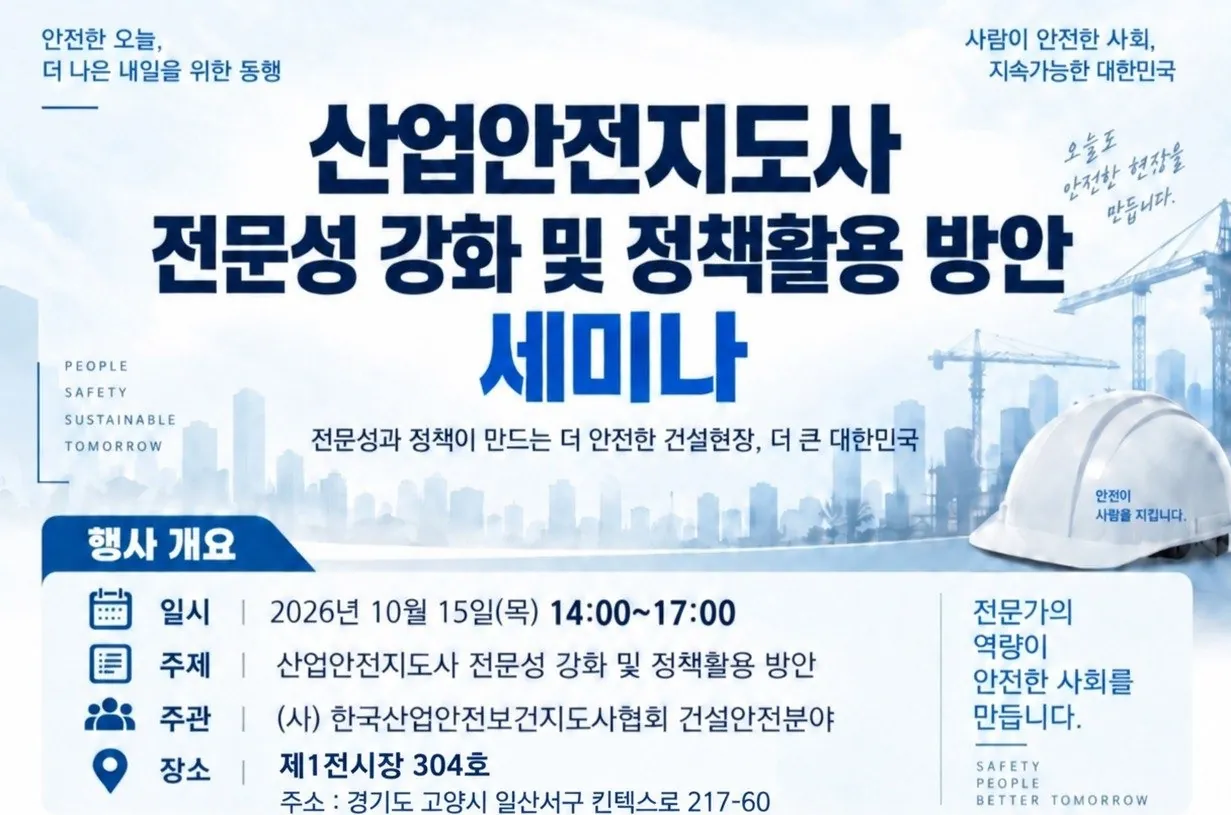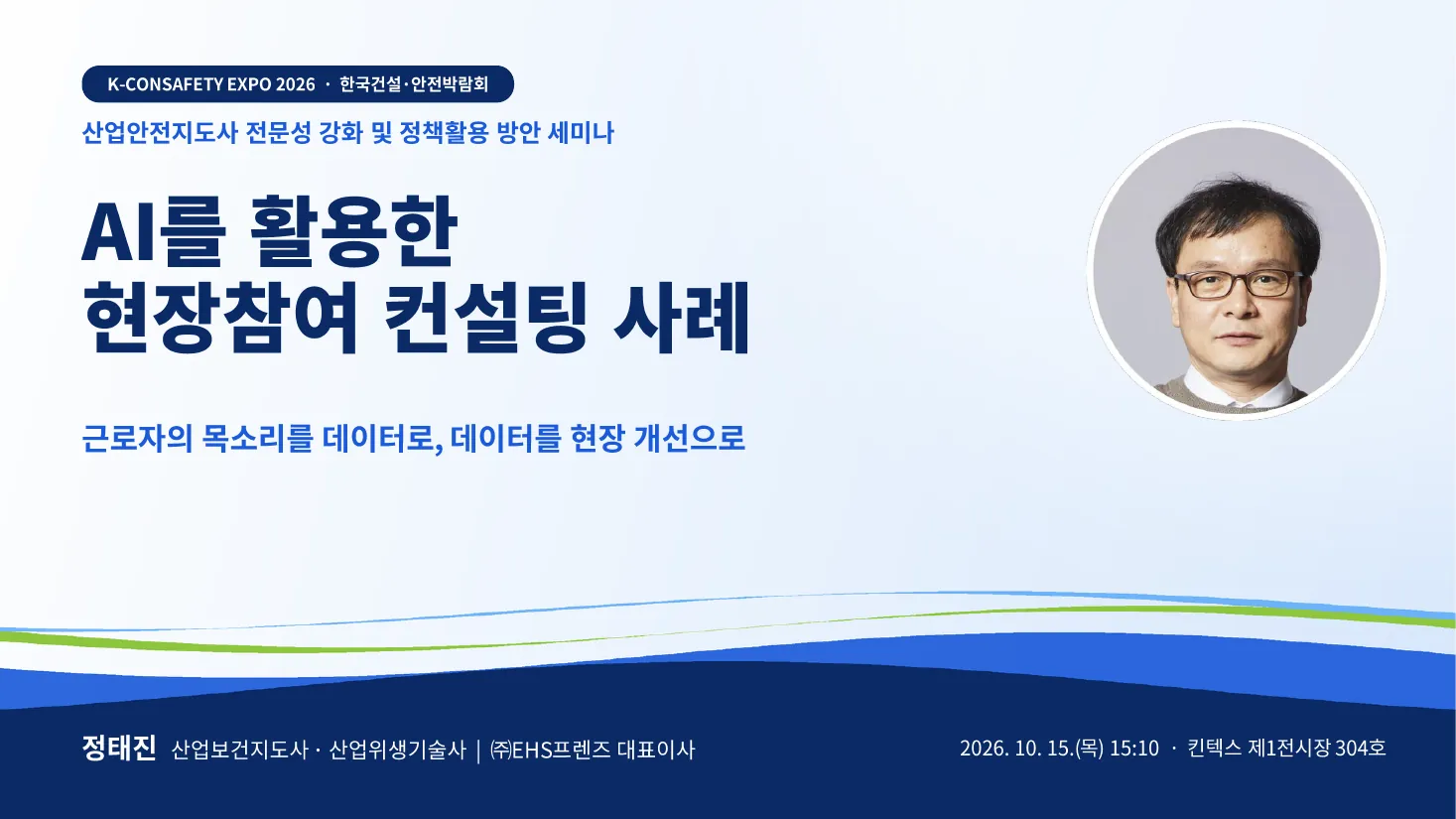
At the Seminar on Strengthening the Expertise of Certified Occupational Safety Consultants and Their Use in Policy, held during the 2026 Korea International Construction & Industrial Safety Expo, EHS Friends CEO Taejin Jeong presented case studies of worker participation consulting, in which AI is used to record and organize workers' input.
The seminar was held during the 2026 Korea International Construction & Industrial Safety Expo (K-CONSAFETY EXPO 2026) and was organized by the Construction Safety Division of the Korea Association of Occupational Safety and Health Consultants. Its theme was strengthening the expertise of Certified Occupational Safety Consultants and making use of them in policy to reduce serious accidents.
Subtitled “From Workers' Voices to Data, from Data to Site Improvements,” the presentation was aimed at Certified Occupational Safety Consultants in construction safety. It reviewed the direction set by the amended Occupational Safety and Health Act (OSH Act), which makes worker participation throughout the risk assessment process, sharing of results, and record keeping mandatory. It then showed how digital records and AI can make up for a limitation of consulting in the field: in a short visit, it is hard to hear from shift and night workers, workers from business partners and day laborers.
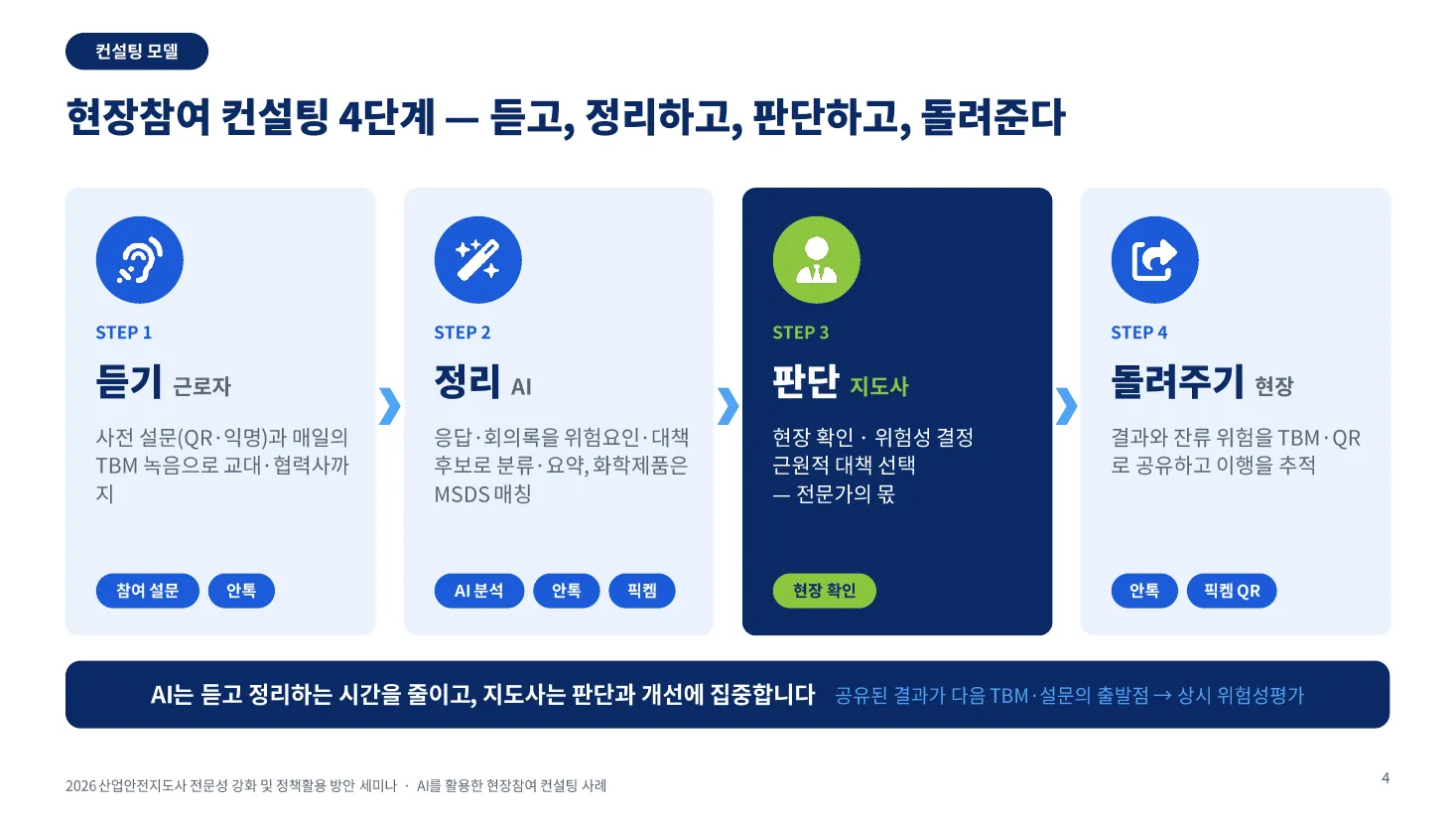
Jeong then explained the four steps of worker participation consulting: listen, organize, judge and give back. Workers' voices are gathered through preliminary surveys and daily recordings of toolbox meetings (TBMs); AI organizes them into candidate hazards and measures; the consultant checks the site, determines the risk and selects the measures; and the results are shared back with the site through TBMs and QR codes so that implementation can be tracked.
The case studies were AnTok, EHS Friends' AI service for TBMs, which turns TBM recordings into meeting minutes, hazard lists and safety and health training logs; PicChem, the AI chemical management service of PicChem Inc. (EHS Friends participated in its development); and risk assessment at a medical institution centered on preliminary surveys and “change points.” Finally, noting that the consultant still signs, and is responsible, even when AI writes the draft, he closed with the message “Leave the paperwork to AI and the field to the consultant.”
Topics Covered
- Policy direction — worker participation, from recommendation to legal obligation (worker participation in risk assessment, sharing of results, record keeping)
- Four steps of worker participation consulting — listen (workers), organize (AI), judge (consultant), give back (site)
- Case 1 · TBM — recording daily TBMs as meeting minutes, hazard lists and training logs with AnTok
- Case 2 · Chemicals — label photos and MSDS matching, chemical risk assessment and on-site sharing via QR code with PicChem by PicChem Inc. (EHS Friends participated in its development)
- Case 3 · Risk assessment — preliminary surveys and an assessment focused on “change points” at a medical institution
- Applications by industry and consulting menus for consultants — logistics, facility management, power generation, hospital and aviation sites
- The consultant's role in the AI era — paperwork to AI, the field to the consultant
Presentation Materials
Case Studies in AI-Assisted Worker Participation Consulting (Korean)
Taejin Jeong (CEO, EHS Friends Co., Ltd.) · PDF (Korean) · 13 pages · 2.0MB
The presentation reviews how the amended OSH Act, in effect since June 2026, makes worker participation throughout the risk assessment process, sharing of results and record keeping mandatory, and how, from January 2027 (January 2028 for workplaces with fewer than 50 workers), failure to comply will be subject to an administrative fine of up to KRW 10 million. It treats worker participation as a matter of “time” and “evidence” and sets out the four steps of worker participation consulting: listen (workers), organize (AI), judge (consultant) and give back (site). It presents three case studies — AnTok (TBM recordings turned into meeting minutes, a five-axis quality score and automatic tallying of training hours), PicChem (label photos, MSDS matching, chemical risk assessment and sharing via QR code), and risk assessment at a medical institution centered on preliminary surveys and “change points” (704 hazards compiled into a database) — along with applications in logistics, facility management, power generation, hospitals and aviation. It closes with four consulting menus for consultants and the consultant's role in the AI era.
Contents (13)
- Case studies in AI-assisted worker participation consulting — from workers' voices to data, from data to site improvements
- Worker participation: from recommendation to legal obligation
- Participation comes down to “time” and “evidence”
- Four steps of worker participation consulting — listen, organize, judge, give back
- AnTok — a daily 10-minute TBM becomes a channel for worker participation
- PicChem — snap, assess, and give back to the site
- Risk assessment at a medical institution — preliminary surveys and an assessment focused on “change points”
- Different industries, the same participation challenge
- In any industry, “participation” is solved with the same structure
- How your consulting can change
- How you can use it in your consulting menu
- When AI writes the paperwork, where does the consultant's expertise lie?
- Paperwork to AI, the field to the consultant