At the 62nd Korean Industrial Hygiene Association (KIHA) Winter Conference, CEO Taejin Jeong organized and ran the Professional Development Course (PDC) “Key Points of the Amended K-REACH and Chemicals Control Act: What Occupational Health Professionals Must Know.” The lectures were given by the National Institute of Chemical Safety (NICS) and by Shinbum Kim, CEO of PicChem Inc.
The conference was held at the Changwon Exhibition and Convention Center (CECO) on February 25–27, 2026, and eight Professional Development Courses (PDCs) ran on the first day. CEO Taejin Jeong organized and ran the second of these courses (PDC2).
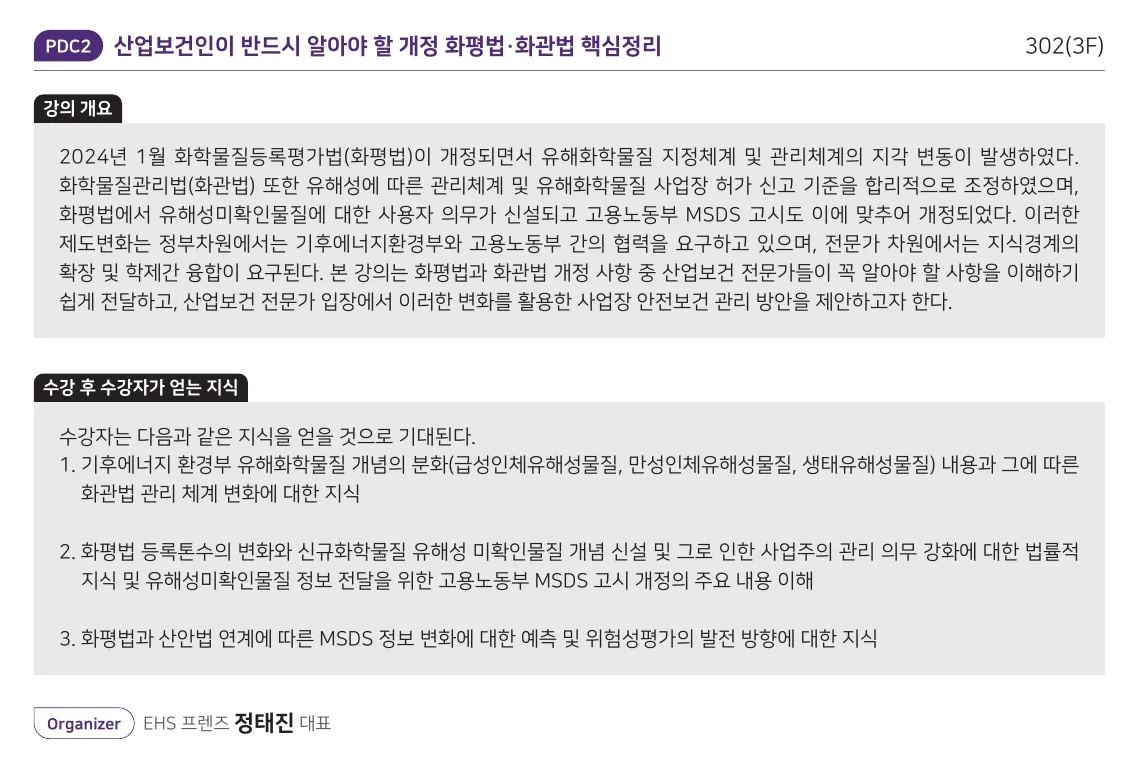
With the January 2024 amendment of the Act on the Registration and Evaluation of Chemicals (K-REACH), the system for designating and managing hazardous chemicals changed substantially, and under the Chemicals Control Act (K-CCA), the hazard-based management system and the permit and reporting criteria for workplaces handling hazardous chemicals were also adjusted. As K-REACH introduced new user obligations for substances with unconfirmed hazards, the Ministry of Employment and Labor (MOEL) also revised its MSDS Notice. The course was designed to summarize what occupational health professionals must know about these changes and to explore how to apply them to safety and health management in the workplace.
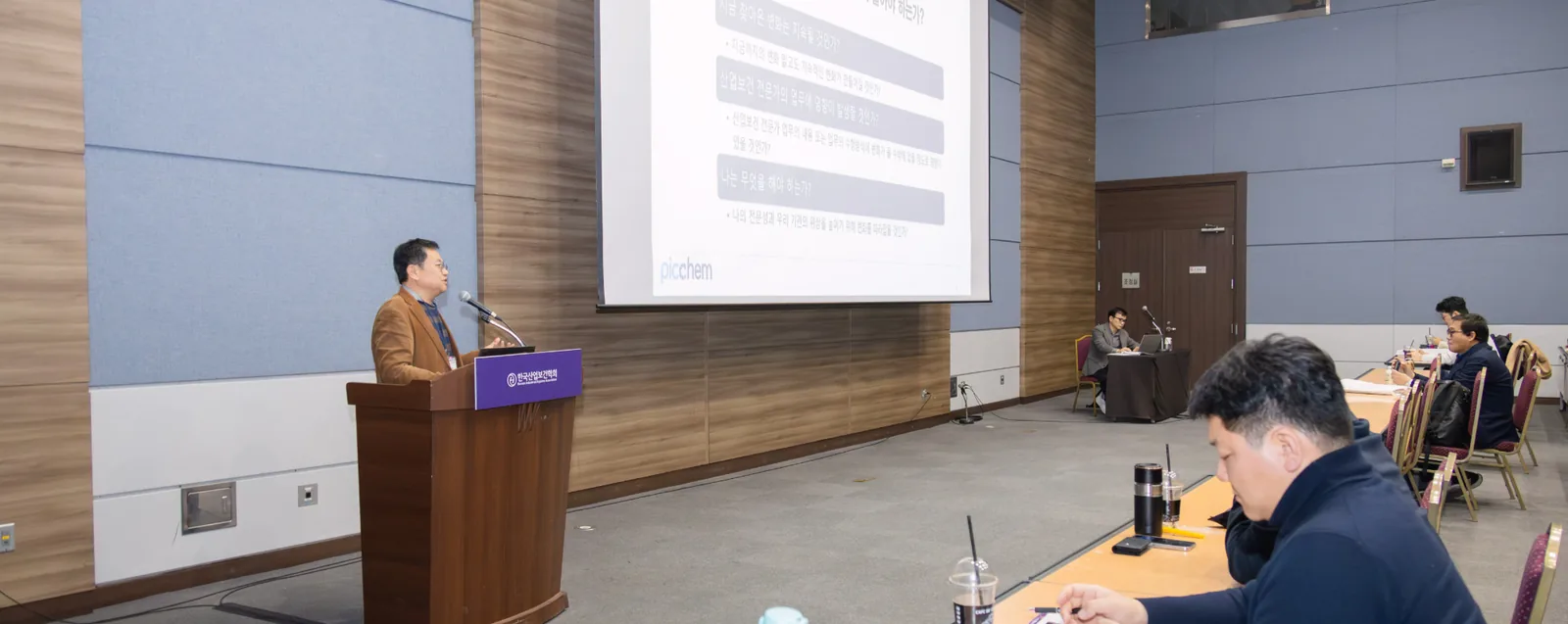
The first lecture, given by the National Institute of Chemical Safety (NICS), covered the shift in the chemical safety management paradigm following the amendments to K-REACH and the K-CCA. The second lecture was given by Shinbum Kim, CEO of PicChem Inc., on the topic “The Need to Link K-REACH and the K-CCA with the Occupational Safety and Health Act, and the Role of Occupational Health Professionals,” under the title “Reasons for the Confusion: The Emergence of Chemical Regulation.”
Tracing the path from European carcinogen regulation in the 1960s to EU REACH and K-REACH, Kim explained that chemical regulation has become independent as chemicals, once covered within separate regulatory areas such as environment, safety and health, came to be recognized as a regulatory area of their own, and that the current changes are only the beginning. He then reviewed how the communication of chemical information has evolved from the Chemical Data Sheet to the MSDS and exposure scenarios, and said that, with information on “substances with unconfirmed hazards” now appearing in MSDSs, occupational health professionals have taken on the role of interpreting this information and explaining how it should be managed. Finally, he outlined emerging issues in occupational health, such as the rising status of risk assessment and the widespread adoption of AI-based management tools. The lecture was followed by a Q&A session.
Topics Covered
- Lecture 1 · The shift in the chemical safety management paradigm following the K-REACH and K-CCA amendments (reorganization of the system for designating and managing hazardous chemicals) — National Institute of Chemical Safety (NICS)
- Lecture 2 · The need to link K-REACH and the K-CCA with the OSH Act, and the role of occupational health professionals (presentation “Reasons for the Confusion: The Emergence of Chemical Regulation”) — Shinbum Kim, CEO of PicChem Inc.
- The subdivision of the hazardous chemical concept by the Ministry of Climate, Energy and Environment (MCEE) into substances with acute human health hazards, chronic human health hazards, and ecological hazards, and changes to the K-CCA management system
- Changes to K-REACH registration tonnage thresholds, the new concept of “substances with unconfirmed hazards” for new chemical substances, and stronger management obligations for employers
- Key revisions to MOEL's MSDS Notice for communicating information on substances with unconfirmed hazards
- Outlook for changes in MSDS information as K-REACH and the OSH Act are linked, and the future direction of risk assessment
Presentation Materials
Reasons for the Confusion: The Emergence of Chemical Regulation (Korean)
Shinbum Kim (CEO, PicChem Inc.) · PDF (Korean) · 35 pages · 5.2MB
Lecture slides presented by Shinbum Kim, CEO of PicChem Inc., at the KIHA 2026 Winter Conference PDC. Starting from the 1960s bans on the use of benzene and carcinogens in Europe and Sweden's exposure limits, the lecture traces how chemical regulation became independent, through EU directives to EU REACH and K-REACH. It then covers the evolution of information communication, from the Chemical Data Sheet to the MSDS, REACH exposure scenarios (SWEDs and SUMIs) and exposure limits (OELs and DNELs), as well as the problem of managing substances with unconfirmed hazards. Finally, it presents emerging issues, such as the rising status of risk assessment and the widespread adoption of AI-based management tools, and the role of occupational health professionals in explaining and translating risk.
Contents (15)
- Reasons for the confusion: the emergence of chemical regulation
- What do occupational health professionals need to know, and why?
- Question 1. Will the changes now under way last?
- The beginnings of carcinogen regulation
- Exposure limits and carcinogens
- The moment of change
- Space-and-receptor frame · source frame · chemical regulation becomes independent
- Answer 1. The current changes are only the beginning
- Question 2. Will this affect the work of occupational health professionals?
- From the Chemical Data Sheet to the MSDS
- Uses in the SDS become linked to regulation
- A flood of complaints about SDS + exposure scenarios
- Risk assessment – information communication
- Answer 2. Occupational health services are being called on to change
- Emerging issues in occupational health