At a roundtable of the 62nd Korean Industrial Hygiene Association (KIHA) Winter Conference, EHS Friends CEO Taejin Jeong presented on welding fume exposure at welding sites in Korea and a management strategy centered on personal protective equipment (PPE).
The presentation was the second in Roundtable 2, “Hazards of Welding Fume and Personal Protection Solutions,” held on the second day of the conference. The session covered, in turn, the health effects of welding fume and the related standards and management systems, exposure at sites in Korea, and trends in the revision of occupational exposure limits in Japan and Australia.
Starting from the change in management direction after the International Agency for Research on Cancer (IARC) reclassified welding fume as a Group 1 carcinogen in 2017, he reviewed exposure levels reported in Korean studies for construction, confined spaces and other settings, and the differences between Korean and international occupational exposure limits for manganese and hexavalent chromium. He also stressed that complying with Korea's legal limits alone cannot guarantee the prevention of health impairment.
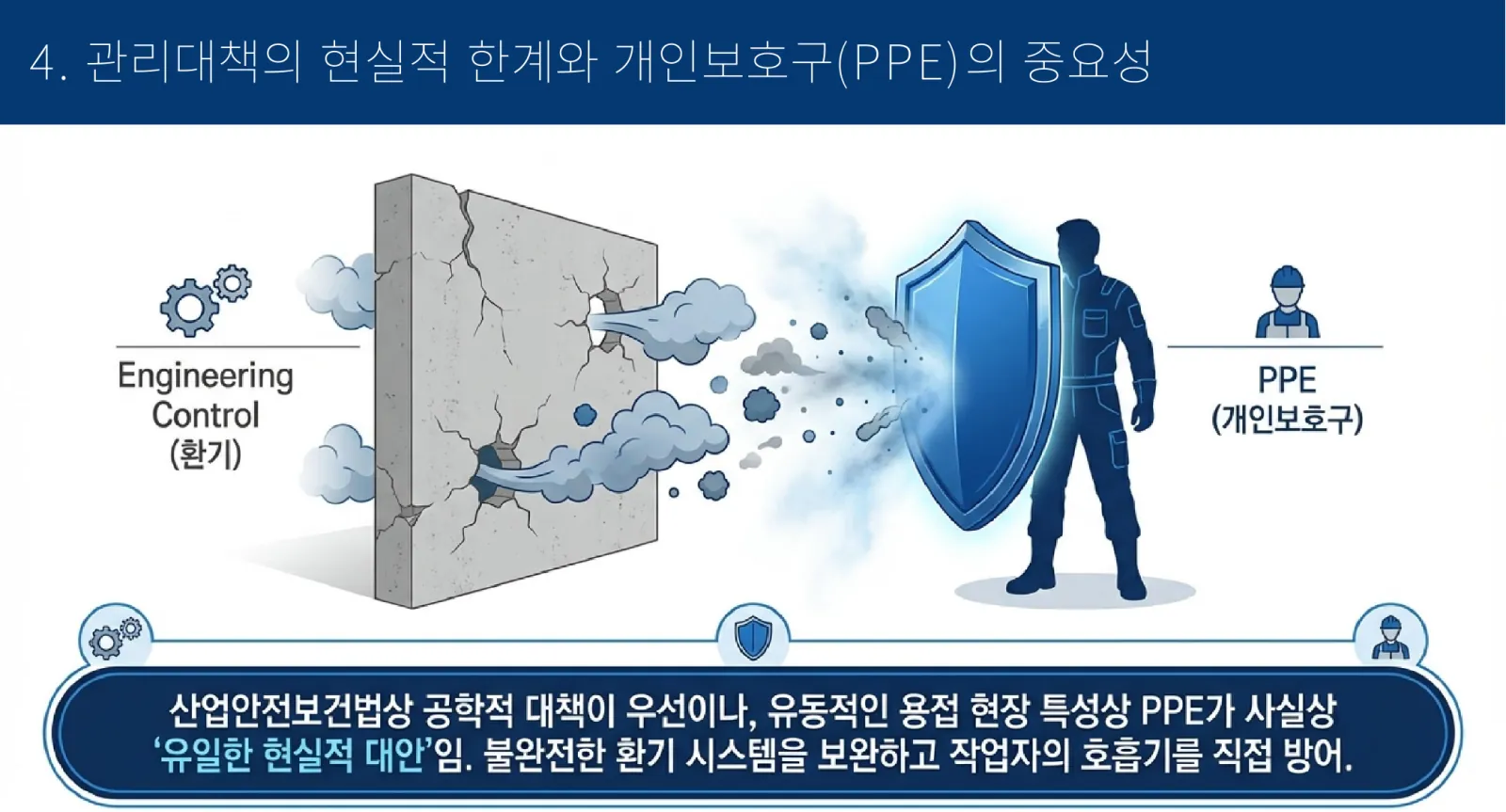
He explained that because work locations change frequently and structures are complex at welding sites, ventilation equipment alone has limits, which makes PPE a realistic alternative and the last line of defense. He then examined why workers avoid wearing PPE and the problem of fit: in the presenter's 2025 data, 463 of 2,930 fit tests (16%) did not achieve an adequate fit.
In conclusion, he recommended using high-performance PPE such as powered air-purifying respirators (PAPRs), institutionalizing fit testing and systematizing training on how to wear PPE, conducting risk assessments based on actual hazards and exposure characteristics, and expanding financial and technical support so that small and medium-sized workplaces can use high-performance PPE.
Topics Covered
- A shift in the welding fume management paradigm — IARC's 2017 reclassification as a Group 1 carcinogen
- Exposure at welding sites in Korea and a comparison of Korean and international occupational exposure limits (manganese, hexavalent chromium)
- Health effects of welding fume and cases of occupational disease
- Practical limits of control measures and the importance of personal protective equipment (PPE)
- Voices from the field — why workers avoid PPE, and failure to achieve a proper fit
- A field-centered PPE management strategy — introducing PAPRs and institutionalizing fit testing
- Summary and conclusions — managing actual toxicity, more substantive risk assessment and expanded support
Presentation Materials
Welding Fume Exposure at Welding Sites in Korea and a PPE-Centered Management Strategy (Korean)
Taejin Jeong (CEO, EHS Friends Co., Ltd.) · PDF (Korean) · 20 pages · 2.8MB
This presentation addresses the direction of welding fume management after the International Agency for Research on Cancer (IARC) reclassified welding fume as a Group 1 carcinogen in 2017. Using data from Korean studies, it shows exposure levels for pipe welders, crane operators and confined-space workers, and summarizes how Korea's occupational exposure limits for manganese and hexavalent chromium are 50 times less stringent than those of the American Conference of Governmental Industrial Hygienists (ACGIH), along with approved workers' compensation claims for lung cancer, COPD and manganese exposure. At welding sites where work moves frequently, engineering controls such as local exhaust ventilation have limits, and workers avoid PPE because of breathing difficulty or heat. On this basis, it proposes introducing powered air-purifying respirators (PAPRs), making fit testing mandatory, more substantive risk assessment and expanded support for small and medium-sized workplaces.
Contents (16)
- Cover: Welding fume exposure at welding sites in Korea and a PPE-centered management strategy
- 1. A shift in the welding fume management paradigm: background (IARC Group 1 carcinogen reclassification) and purpose of the presentation
- 1. A shift in the welding fume management paradigm: definition (ultrafine solid particles of 0.01–1 μm) and combined hazards
- 2. Exposure at welding sites in Korea: high-exposure groups, risks of indirect exposure, confined spaces
- 2. Exposure at welding sites in Korea: differences between Korean and international exposure limits (manganese, hexavalent chromium; Korea's MOEL vs. the U.S. ACGIH)
- 3. Health effects of welding fume and cases of occupational disease: 812 deaths from accidents vs. 1,206 deaths from disease; welding fume as a “slow killer”
- 3. Health effects of welding fume and cases of occupational disease: health effects of manganese, hexavalent chromium, ozone/NOx and zinc/copper
- 3. Health effects of welding fume and cases of occupational disease: Case 1 lung cancer, Case 2 COPD (chronic obstructive pulmonary disease)
- 3. Health effects of welding fume and cases of occupational disease: Lesson: levels below the limit do not guarantee safety
- 3. Health effects of welding fume and cases of occupational disease: IARC (International Agency for Research on Cancer), changing legal trends, implications
- 4. Practical limits of control measures and the importance of PPE: mobility, structural challenges, sharp drops in efficiency
- 5. Voices from the field: why do workers avoid PPE? Breathing difficulty 46.4%, sweat and heat 38.7%, frequent removal and refitting 20.8%, pain 14.3% / interference with work, misconceptions, fit failure
- 6. Recommendations for a field-centered PPE management strategy: introducing PAPRs and combined protection, institutionalizing fit testing for tight-fitting respirators
- 7. Summary and conclusions: from “complying with legal limits” to “managing actual toxicity” / rethinking the status of PPE
- 7. Summary and conclusions: from “simply handing out PPE” to “institutionalized fit testing” / more substantive risk assessment and expanded support
- Closing: safety that forces discomfort on workers does not deliver safety