
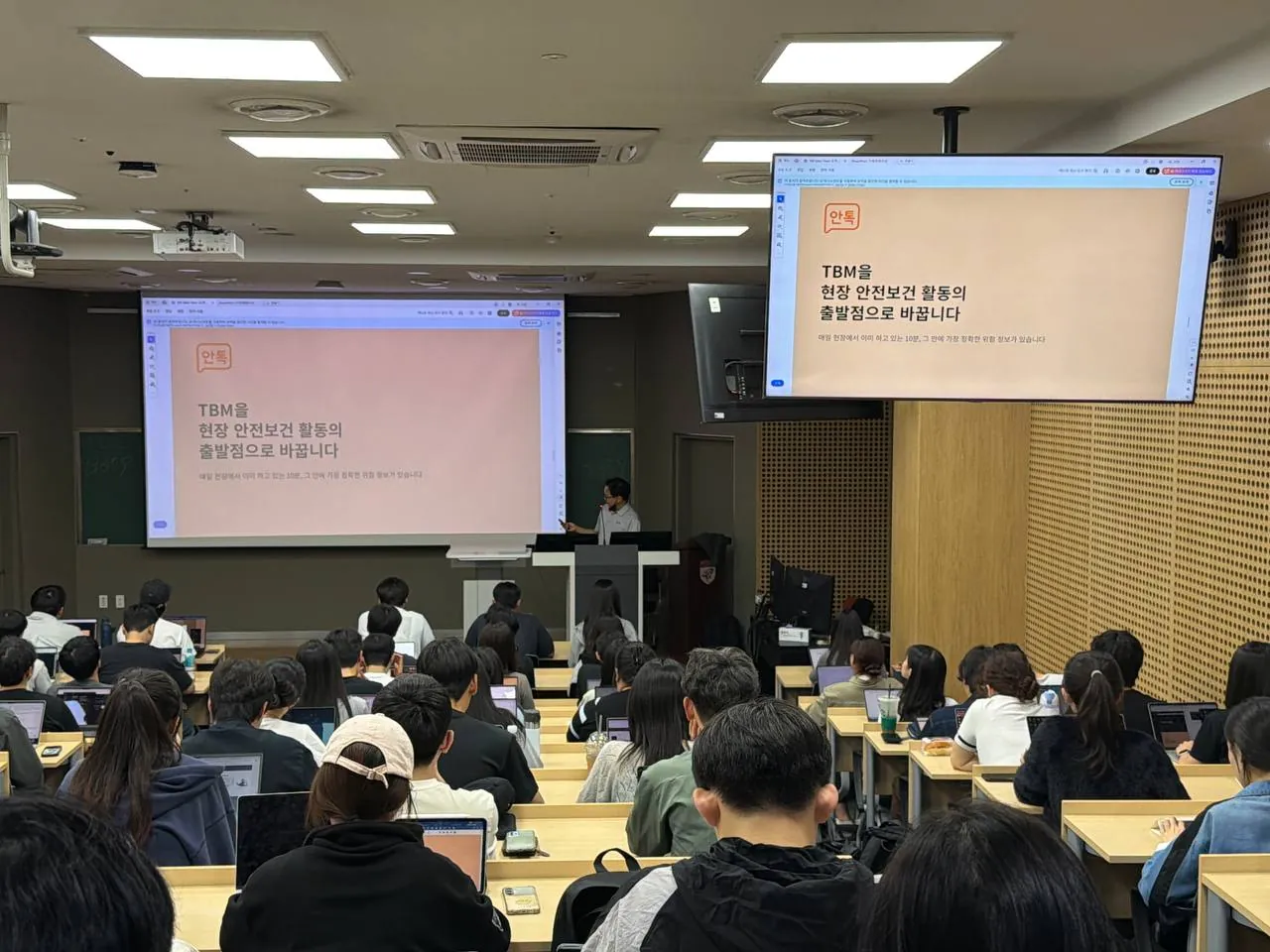
In Korea University's special lecture series “Chemical Management and AI,” EHS Friends CEO Taejin Jeong used two field cases, chemical management and toolbox meetings (TBMs), to show how AI is changing safety and health work.
In Korea University's special lecture series “Chemical Management and AI,” CEO Taejin Jeong gave a lecture titled “How AI Is Changing the Work of Safety and Health.” Rather than introducing products, the lecture focused on showing through case studies what changed when AI was used in the field and what remained the work of people. In an interlude before the main presentation, he and the students reflected on how people choose their work and the values they want to pursue through it.
The first case was chemical management. He presented how PicChem is used: a single photo of a label is matched to its MSDS, the substance list, warning labels and regulatory information are organized, and the process continues to chemical risk assessment and on-site sharing via QR code. PicChem is a product of PicChem Inc.; EHS Friends participated in its development as a chemical-management domain partner.
The second case was the toolbox meeting (TBM), a pre-work safety meeting. He showed how recording a TBM with AnTok, developed and operated by EHS Friends, automatically produces meeting minutes, while tasks, hazards and measures build up as data that feed into risk assessment, safety and health training records and site-by-site risk statistics. He also covered features that check TBM quality with a five-axis score and automatically tally statutory training hours.
Finally, he looked back on how, in both cases, AI handled finding, reading and organizing information, while people judged exposure situations and decided on measures. The lecture closed with him and the students considering the question “How should experts use AI?”
Topics Covered
- Interlude — how we choose our work and the values we want to pursue through it
- The problem in the field — safety and health staff's time tied up in paperwork
- Case 1. Chemical management with AI — label photos and MSDS matching, chemical risk assessment, on-site sharing via QR code (PicChem)
- Case 2. TBM management with AI — meeting minutes from recordings, a five-axis TBM score, automatic tallying of statutory training hours (AnTok)
- Looking back on the two cases — what AI did and what people did
- A final question — how should experts use AI?
Presentation Materials
How AI Is Changing the Work of Safety and Health – Two Field Cases: Chemical Management and TBM, Korea University Special Lecture (Korean)
Taejin Jeong (CEO, EHS Friends Co., Ltd.) · PDF (Korean) · 19 pages · 1.4MB
The presentation opens with an interlude asking how we choose our work (financial reward, social recognition, altruism, and Donald E. Super's “14 values people pursue through work”). It then presents two field cases in which AI is used so that safety and health staff can focus on the field rather than on paperwork. In Case 1, PicChem automatically organizes the substance list, warning labels, regulatory information and chemical risk assessment from just a label photo or an MSDS upload (MSDS database of 250,000+ entries; Source: PicChem). In Case 2, AnTok produces meeting minutes, a list of site hazards, comprehensive analysis reports and safety and health training logs from TBM recordings alone, feeding into risk assessment and training. Finally, it sets what AI did side by side with what people did and asks how experts should use AI.
Contents (15)
- Interlude – on the value of work
- What do we look at when we choose our work?
- If you could choose only two things you must pursue through your work, what would they be?
- How AI is changing the work of safety and health
- Safety and health staff should focus on the field, not on paperwork
- CASE 1 · Chemical management with AI
- Chemicals are linked to far more deaths than the statistics show
- Automating chemical management with photos
- Snap, assess, and give back to the site
- CASE 2 · TBM management with AI
- Making the TBM the starting point of on-site safety and health activities
- Just turn on AnTok during your TBM
- These records build up from TBM recordings alone
- Looking back on the two cases – what AI did and what people did
- A final question · How should experts use AI?