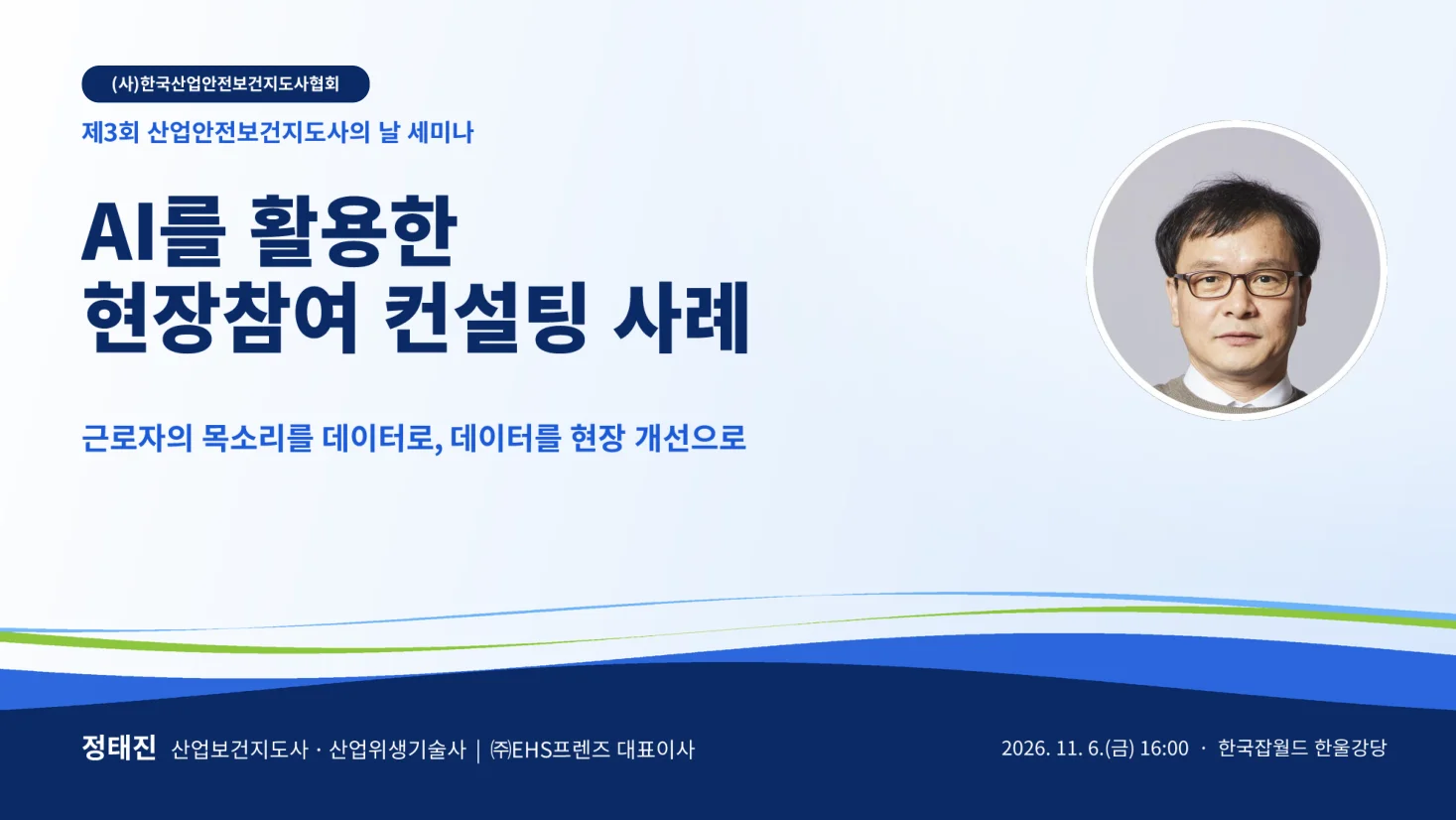
At the 3rd Occupational Safety and Health Consultants' Day Seminar (November 6, Korea Job World), EHS Friends CEO Taejin Jeong presented case studies of worker participation consulting, in which workers' voices gathered through preliminary surveys and toolbox meeting recordings are organized by AI and carried through to risk assessment and site improvements.
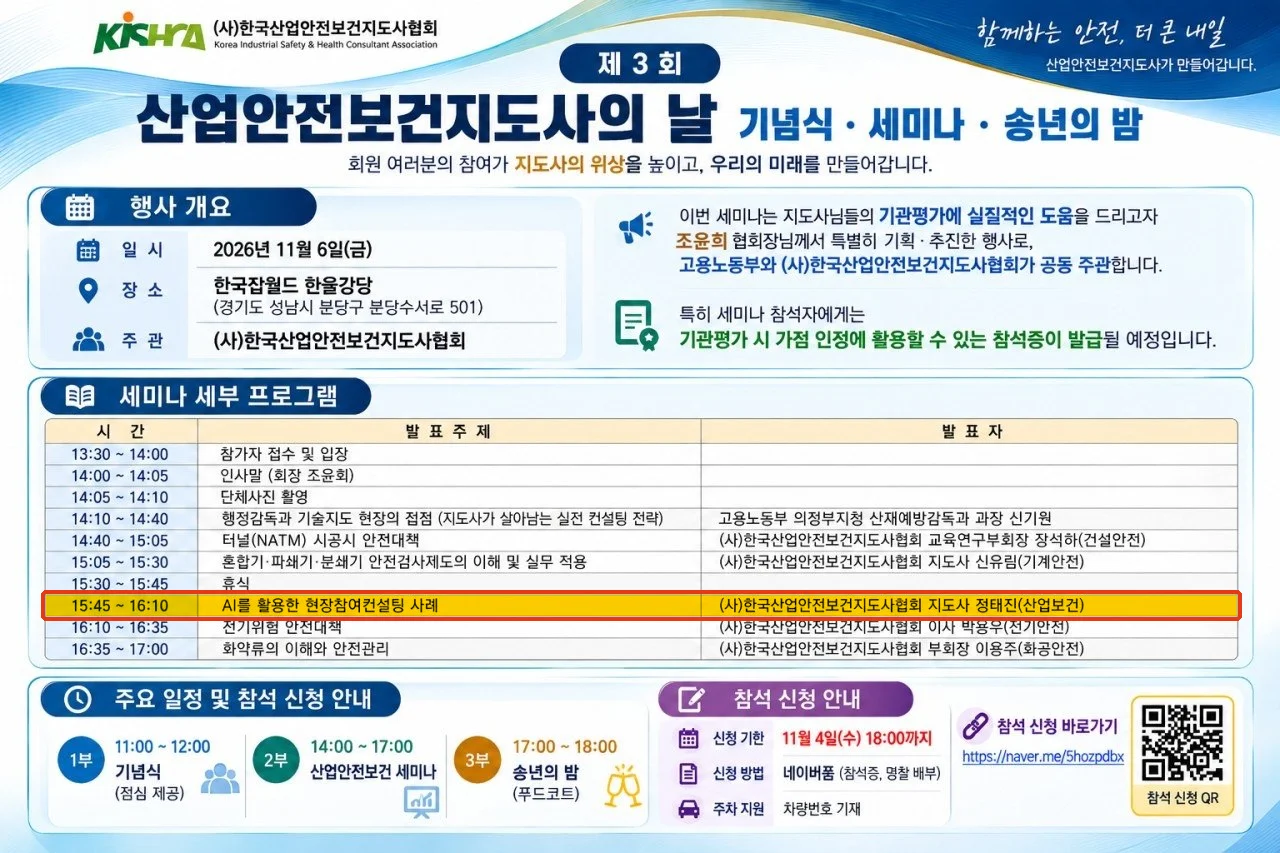
The 3rd Occupational Safety and Health Consultants' Day was held by the Korea Industrial Safety & Health Consultant Association on November 6, 2026, at Korea Job World in Seongnam, with a commemorative ceremony, a seminar and a year-end party. The afternoon seminar was co-organized by the Ministry of Employment and Labor and the Association to give consultants practical help with their performance evaluations, and attendees were told they would receive a certificate of attendance that could earn bonus points in those evaluations. The program included talks on administrative supervision and technical guidance, tunnel construction, and machinery, electrical and explosives safety, and CEO Taejin Jeong spoke as a consultant in occupational health.
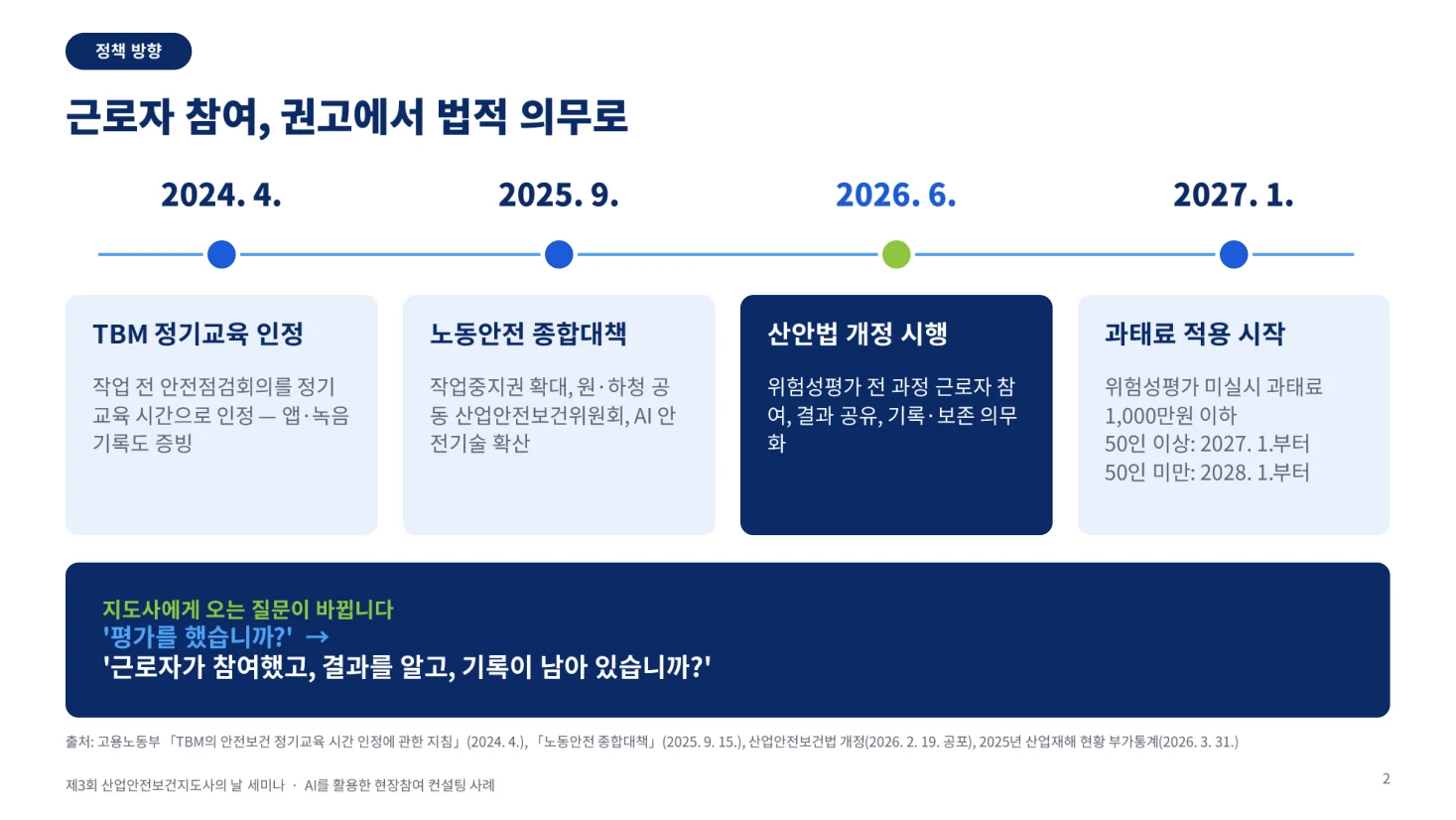
His talk was subtitled “From Workers' Voices to Data, from Data to Site Improvements.” He had presented the material to construction safety consultants at KINTEX in October; this time he covered it for consultants from all fields. He traced how worker participation has moved from recommendation to legal obligation: in 2024, toolbox meeting (TBM) time was recognized as regular safety and health training; 2025 brought the Comprehensive Labor Safety Measures; in June 2026, the amended Occupational Safety and Health Act (OSH Act) took effect, making worker participation throughout the risk assessment process, sharing of results and record keeping mandatory; and administrative fines apply from January 2027 (January 2028 for workplaces with fewer than 50 workers). As a result, he explained, the question consultants are asked is changing from “Did you carry out the assessment?” to “Did workers take part, do they know the results, and is there a record?”
In the field, the difficulty comes down to time and evidence. A short visit means meeting only some of the workers, and the views of shift and night workers, workers from business partners and day laborers are easily missed. The talk addressed this with four steps — listen, organize, judge and give back: workers are heard, AI organizes, the consultant judges, and the results go back to the site. Input is gathered through anonymous preliminary surveys (via QR code) and daily TBM recordings; AI classifies and summarizes it as candidate hazards and measures; the consultant checks the site, determines the risk and chooses measures that address root causes; and the results and residual risks are shared back with the site through TBMs and QR codes so that implementation can be tracked.
The case studies were AnTok, EHS Friends' AI service for TBMs, which produces meeting minutes, hazard lists and training logs from recordings and gives each TBM a five-axis quality score; PicChem, the AI chemical management service of PicChem Inc. (EHS Friends participated in its development), which covers label photos and MSDS matching, chemical risk assessment and on-site sharing via QR code; and risk assessment at a medical institution centered on preliminary surveys and “change points.” He also showed how to combine these for logistics, facility management, power generation, hospital and aviation sites, and proposed services consultants could add to their consulting menu, such as participatory risk assessment, TBM coaching, chemical management and ongoing management contracts. He closed with the message “Leave the paperwork to AI and the field to the consultant” and a call for consultants to help build worker participation consulting together.
Topics Covered
- Policy direction — worker participation, from recommendation to legal obligation (TBM time recognized as regular safety and health training, the Comprehensive Labor Safety Measures, the amended OSH Act, fines for not conducting risk assessments)
- The reality on site — participation comes down to “time” and “evidence”; DX (digital transformation: changing how participation is recorded) and AX (AI transformation: AI organizing the accumulated voices)
- Four steps of worker participation consulting — listen (workers), organize (AI), judge (consultant), give back (site)
- Case 1 · TBM — recording daily 10-minute TBMs as meeting minutes, hazard lists and training logs with AnTok
- Case 2 · Chemicals — label photos and MSDS matching, chemical risk assessment and on-site sharing via QR code with PicChem by PicChem Inc. (EHS Friends participated in its development)
- Case 3 · Risk assessment — preliminary surveys and an assessment focused on “change points” at a medical institution (704 hazards from the previous year compiled into a database)
- Consulting menus for consultants — participatory risk assessment, a TBM coaching program, chemical management and assessment, ongoing management contracts
- The consultant's expertise in the AI era — responsibility, the field, trust and role; paperwork to AI, the field to the consultant
Presentation Materials
Case Studies in AI-Assisted Worker Participation Consulting — 3rd Occupational Safety and Health Consultants' Day Seminar (Korean)
Taejin Jeong (CEO, EHS Friends Co., Ltd.) · PDF (Korean) · 13 pages · 2.3MB
Written for Certified Occupational Safety and Health Consultants, the presentation traces how worker participation is moving from recommendation to legal obligation (TBM time recognized as regular safety and health training in 2024 → the Comprehensive Labor Safety Measures in 2025 → the amended OSH Act in effect from June 2026 → fines from January 2027, or January 2028 for workplaces with fewer than 50 workers). Treating participation as a matter of “time” and “evidence,” it sets out the four steps of worker participation consulting: listen (workers), organize (AI), judge (consultant) and give back (site). It presents case studies of EHS Friends' AnTok (TBM recordings turned into meeting minutes, a five-axis quality score and automatic tallying of training hours), PicChem by PicChem Inc. (EHS Friends participated in its development; label photos, MSDS matching, chemical risk assessment and sharing via QR code) and risk assessment at a medical institution centered on preliminary surveys and “change points,” along with applications by industry, four consulting menus and the consultant's role in the AI era.
Contents (13)
- Case studies in AI-assisted worker participation consulting — from workers' voices to data, from data to site improvements
- Worker participation: from recommendation to legal obligation
- Participation comes down to “time” and “evidence”
- Four steps of worker participation consulting — listen, organize, judge, give back
- AnTok — a daily 10-minute TBM becomes a channel for worker participation
- PicChem — snap, assess, and give back to the site
- Risk assessment at a medical institution — preliminary surveys and an assessment focused on “change points”
- Different industries, the same participation challenge
- In any industry, “participation” is solved with the same structure
- How your consulting can change
- How you can use it in your consulting menu
- When AI writes the paperwork, where does the consultant's expertise lie?
- Paperwork to AI, the field to the consultant