
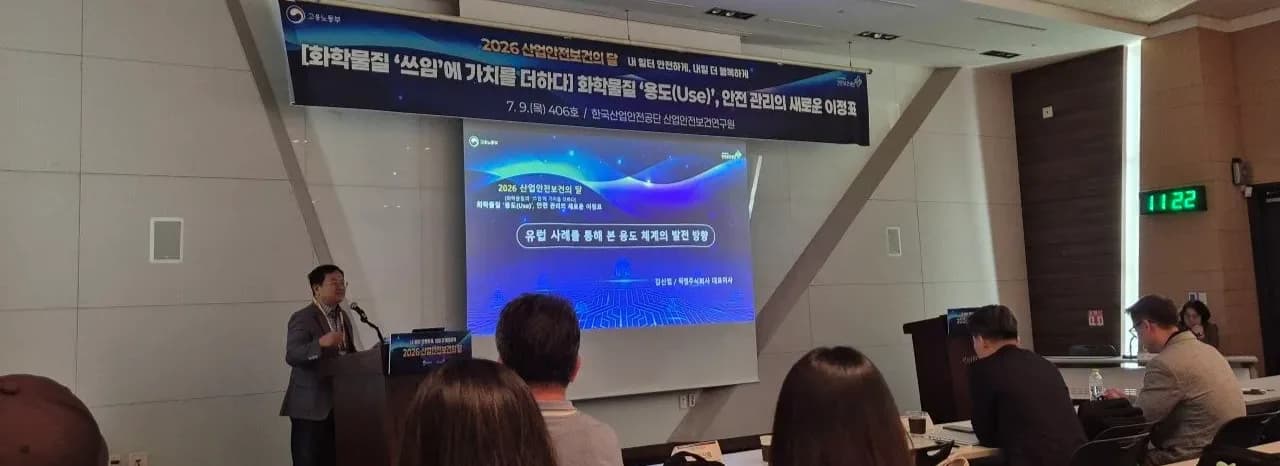
At the 2026 Occupational Safety and Health Month seminar “[Adding Value to How Chemicals Are Used] Chemical Use: A New Milestone in Safety Management,” Shinbum Kim, CEO of PicChem Inc., presented on the future direction of Korea's chemical use system in light of European cases.
As one of the safety and health seminars at the main events of 2026 Occupational Safety and Health Month (July 6–10, KINTEX Exhibition Center 2), the seminar “[Adding Value to How Chemicals Are Used] Chemical Use: A New Milestone in Safety Management,” organized by the Occupational Safety and Health Research Institute (OSHRI) of the Korea Occupational Safety and Health Agency (KOSHA), was held on the morning of July 9 in Room 406. The seminar set out to shed new light on the value of chemical “use” from a health perspective, and to explore how use data in MSDSs and under the Act on the Registration and Evaluation of Chemicals (K-REACH) can be extended into approaches for exposure management.
Following presentations by OSHRI's MSDS Evaluation Department, the Wonjin Institute for Occupational and Environmental Health (WIOEH) and Kyungsung University, Shinbum Kim, CEO of PicChem Inc., was the fourth and final presenter, speaking on “Future Directions for the Chemical Use System in Light of European Cases.” He opened with a question contrasting chloroform used secretly as a cleaning agent with chloroform whose use is disclosed in the MSDS, asked who determines a use and what responsibilities come with that decision, and posed the question of whether, if work is something that is designed and managed, the exposure risks from chemicals could also be designed.
He then described how the European Union, moving from its 2001 White Paper on chemicals management strategy to the adoption of REACH in 2006, required exposure scenarios to be prepared at the registration stage, risk management measures (RMMs) to be derived for each scenario through risk assessment, and these to be communicated through the MSDS. To this end, uses that had been defined by function were systematized into five use descriptors (SU, PROC, ERC, PC and AC), turning use into information that explains exposure, and downstream users became obliged to check that their uses match those in the MSDS and to implement the risk management measures set out by the registrant.
By contrast, he noted, Korea introduced K-REACH but has not fully moved away from function-based uses and is struggling to collect use information from downstream users, so the responsibility of downstream users to use chemicals only for uses whose risks have been assessed has not taken hold. He stressed the need to quickly find ways to turn functional use information into indicators that explain exposure, and to develop ways of linking and using the MSDS information submitted to KOSHA together with the K-REACH registration information of the Ministry of Climate, Energy and Environment (MCEE).
Finally, he identified the challenges facing occupational health in Korea — reorganizing the designation system for controlled substances, the rising status of risk assessment, and the changes brought by AI along with the shifting role of occupational health professionals — and proposed moving chemical risks into the realm of “designed risk (controlled risk)” based on a use database and “registration risk assessment + workplace risk assessment of use.” Noting that even in Europe it took ten years or more from the introduction of REACH to the emergence of Use Maps, SUMIs and SDS DX, he recommended preparing a roadmap and reflecting it in the national plan required by the Occupational Safety and Health Act (OSH Act); establishing the identity and role of the domain that will build AI-ready data, rather than rushing to use AI technology; and building consensus that occupational health professionals must play their part so that the public recognizes the value of the state and its institutions.
The presentation slides can be downloaded from the seminar schedule on the 2026 Occupational Safety and Health Month website. Shinbum Kim is an EHS Friends Advisor, and EHS Friends participated in the development of PicChem, PicChem Inc.'s AI service for chemical management, as a chemical-management domain partner.
Topics Covered
- Opening question — who determines a use, and what responsibilities come with that decision?
- The ontology of use and risk — work that is designed and managed, exposure that can be designed
- Building proactive risk management into regulation — EU REACH's “No data, no market,” business operators' duties and registration under K-REACH, and use-related exposure information
- The European use system — five use descriptors, and downstream users' obligation to carry out chemical safety assessments
- How K-REACH differs from EU REACH, and the confusion REACH went through
- Where we stand and the challenges ahead — reorganizing the designation system for controlled substances, the rising status of risk assessment, the arrival of AI and the shifting role of professionals
- Recommendations — a roadmap reflected in the national plan, building AI-ready data, and redefining the value of the state, institutions and professionals